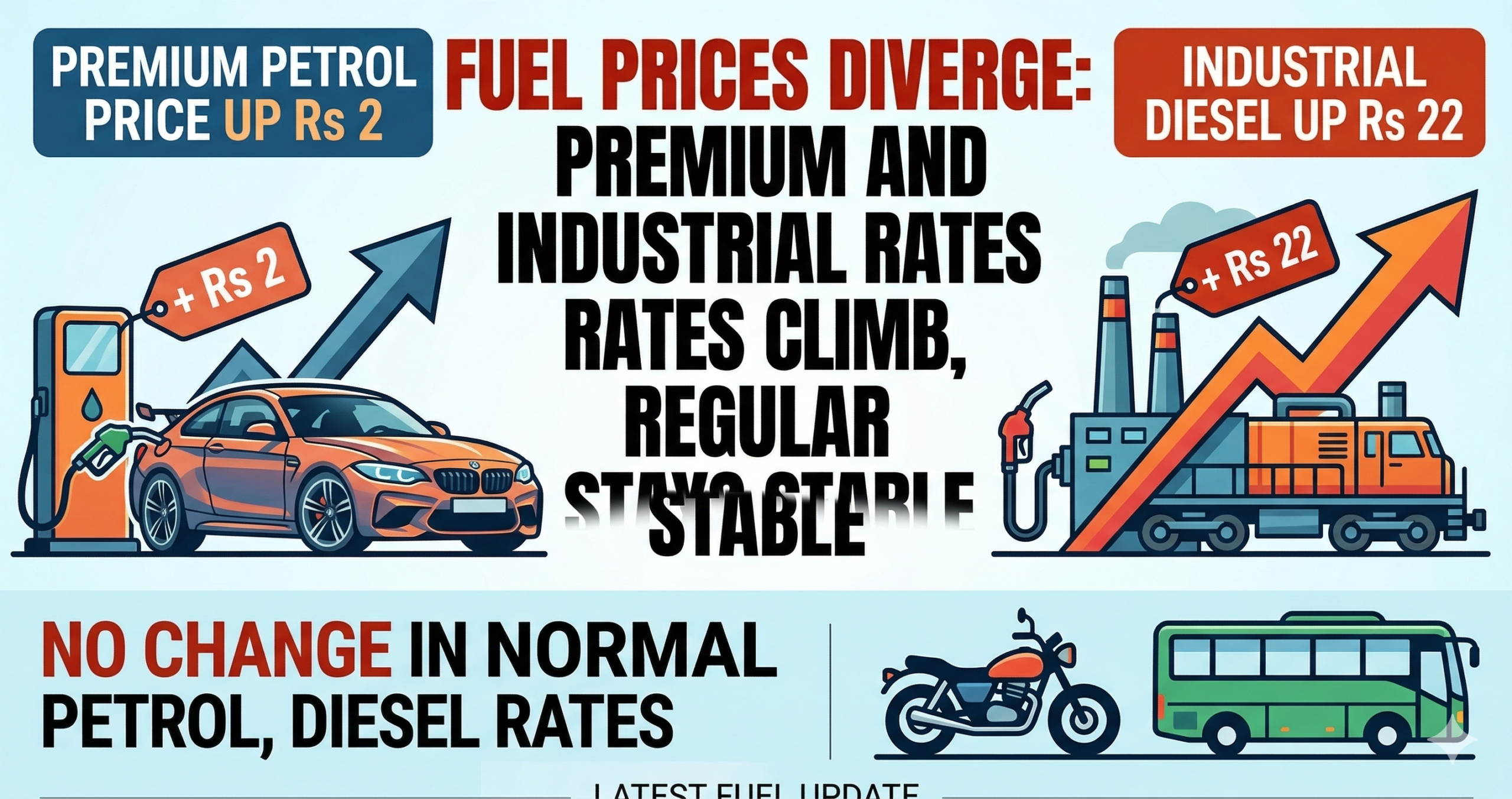
India witnessed a targeted fuel price revision on Friday, March 20, 2026, as oil marketing companies (OMCs) raised the price of premium petrol by Rs 2 per litre and industrial (bulk) diesel by approximately Rs 22 per litre. The hike, driven by the escalating West Asia conflict and a surge in global crude oil prices, does not affect regular petrol and diesel rates used by everyday consumers.
What Changed in Fuel Prices? A Quick Breakdown
Here is a clear snapshot of the revised fuel prices effective March 20, 2026, in Delhi:
| Fuel Type | Old Price (Rs/litre) | New Price (Rs/litre) | Change |
|---|---|---|---|
| Premium Petrol (95-Octane) | Rs 99.89 | Rs 101.89 | +Rs 2.00 |
| Industrial/Bulk Diesel | Rs 87.67 | Rs 109.59 | +Rs 22.00 |
| Normal Petrol (91-92 Octane) | Rs 94.77 | Rs 94.77 | No Change |
| Regular Diesel (retail) | Rs 87.67 | Rs 87.67 | No Change |
In Mumbai, industrial diesel rose from Rs 90.39 to Rs 113.11 per litre (up Rs 22.72). In Kolkata, it moved from Rs 92.30 to Rs 114.27 (up Rs 21.97), and in Chennai from Rs 92.54 to Rs 113.38 per litre (up Rs 20.84).
Why Did Fuel Prices Go Up? The Global Crude Oil Context
The fuel price revision is a direct consequence of spiralling global crude oil prices triggered by the intensifying conflict in West Asia. International oil prices briefly touched USD 119 per barrel on Thursday before pulling back to around USD 108 a barrel — levels not seen since the Russia-Ukraine crisis of 2022.
India is particularly vulnerable to such developments for a straightforward reason: the country imports nearly 88 per cent of its crude oil needs and about half of its natural gas requirement. A significant portion of these supplies transits through the Strait of Hormuz — the narrow waterway between Iran and Oman that serves as a critical chokepoint for global energy trade.
Following military strikes on Iranian government, military and nuclear facilities, Iran issued warnings to shipping in the strait, and insurers pulled coverage, effectively halting tanker movements. This supply disruption instantly sent shockwaves through global energy markets, pushing crude prices sharply higher.
What Is Premium Petrol and Who Uses It?
Not all petrol is the same. Understanding the difference between regular and premium petrol helps clarify why this hike has limited impact on most Indian consumers.
Normal Petrol carries an octane rating of 91–92. It is the standard grade suitable for most everyday vehicles and is what the vast majority of Indian car and two-wheeler owners use.
Premium Petrol boasts a higher octane rating of 95–98. Branded variants like HPCL’s Power95, IOCL’s XP95, and BPCL’s Speed fall in this category. These fuels are designed for high-performance, turbocharged, or high-compression engines — typically found in premium sedans, SUVs, and sports cars.
As Sujata Sharma, Joint Secretary at the Ministry of Petroleum and Natural Gas, pointed out at a press briefing, premium petrol accounts for only 2–4 per cent of total petrol sold in India. The revised prices affect a small, relatively affluent segment of the market.
What Is Industrial Diesel and Why Did It Jump So Steeply?
The Rs 22 hike in industrial or bulk diesel is more significant in quantum but applies specifically to commercial/bulk consumers — not regular retail users at petrol pumps.
Industrial diesel is sold in large quantities to businesses that use it to power generators, telecom towers, data centres, and other heavy industrial equipment. Unlike retail diesel — which is price-controlled for consumers — bulk diesel pricing is more market-linked and therefore more responsive to international crude price movements.
The dramatic Rs 22 jump per litre reflects just how sharply global crude costs have spiked. This will likely raise operating costs for telecom companies, manufacturing units, and businesses that rely heavily on diesel-based power backup, and could translate into some downstream cost pressures.
No Relief Cut for Consumers: Retail Prices Frozen Since 2022
One important backdrop to this story: retail petrol and diesel prices in India have remained frozen since April 2022, even as global crude prices have swung wildly in both directions.
State-run fuel retailers — Indian Oil Corporation (IOC), Bharat Petroleum Corporation (BPCL), and Hindustan Petroleum Corporation (HPCL) — have been absorbing losses during periods of high crude prices and booking profits when rates soften. In FY24, the three companies reported a combined record profit of over Rs 81,000 crore, which helped compensate for the losses sustained during periods of elevated crude costs. For the December 2025 quarter alone, the trio collectively posted Rs 23,743 crore in profit.
The government has consistently prioritised shielding the common man from fuel price volatility. At the briefing, Sharma reiterated: “There is no increase in price for the common man.” She also clarified that pricing decisions rest with the OMCs, since petrol and diesel pricing was deregulated in 2010 and 2014 respectively — the government does not directly set retail fuel prices.
Is a Broader Fuel Price Hike on the Cards?
This is the question on many minds. The government’s current stance is cautious but clear: there is no immediate plan to raise retail fuel prices. OMCs are expected to absorb the current cost pressure for the time being.
However, this stance is contingent on crude prices not rising further. With oil still above USD 100 a barrel and the West Asia conflict showing no signs of imminent resolution, the risk of a broader retail hike cannot be entirely ruled out. Indian Oil Corporation itself acknowledged the pressures on social media, noting that it had ensured no increase in regular automotive fuel prices “even amid rising international costs.”
The government is closely monitoring global oil markets and will likely act only if there is a substantial and sustained spike that makes continued absorption untenable.
Key Takeaways
- Premium petrol (95-Octane, brands like XP95, Power95) is Rs 2/litre more expensive from March 20, 2026.
- Industrial/bulk diesel has risen by ~Rs 22/litre, impacting businesses and commercial users.
- Regular petrol and diesel prices at retail pumps remain unchanged.
- The hike reflects global crude oil prices surging above USD 119/barrel due to the West Asia conflict and disruptions at the Strait of Hormuz.
- The government has no immediate plan to raise retail fuel prices for the common consumer.
- Premium petrol represents only 2–4% of total petrol consumption in India, limiting the impact on most users.
Frequently Asked Questions (FAQs)
Q1. Has the price of normal petrol increased today? No. Normal petrol prices remain unchanged. Only premium petrol (95-Octane variants) has been revised upward by Rs 2 per litre.
Q2. What is the new price of premium petrol in Delhi? Premium 95-Octane petrol in Delhi now costs Rs 101.89 per litre, up from Rs 99.89 per litre.
Q3. Why has industrial diesel increased so much? Industrial/bulk diesel is more market-linked than retail diesel, so it directly reflects the surge in global crude oil prices triggered by the West Asia conflict.
Q4. Will normal petrol and diesel prices increase soon? The government has stated there is no immediate plan to raise retail fuel prices. OMCs are expected to absorb costs in the near term, though the situation depends on how crude prices evolve.
Q5. Which brands of premium petrol are affected? HPCL’s Power95, IOCL’s XP95, and BPCL’s Speed are among the premium fuel brands that have seen a price increase.
Stay updated on the latest fuel prices, crude oil trends, and energy news on our website.